


Pet-friendly Greece is becoming increasingly appealing to travelers who do not want to leave their dogs at home. With long coastlines, outdoor restaurants, holiday homes with gardens and many quiet beaches, Greece can be a wonderful destination for a holiday with a pet.
We regularly travel to Greece with our Labrador and pug, and our experience has generally been very positive. They have joined us on road trips, stayed with us in apartments and houses, walked through seaside villages and enjoyed swimming at Greek beaches.
However, travelling with a dog requires some preparation. You need the correct documents, suitable accommodation and a basic understanding of where dogs are legally allowed. Beach rules are particularly important because Greek law distinguishes between organised and unorganised beaches.
This guide combines the official rules with our personal experience of travelling in Greece with two very different dogs.
Pet-Friendly Greece: What to Expect
Greece can certainly be described as pet-friendly, although the experience depends on the destination, accommodation and season.
In coastal areas, much of daily life happens outdoors. Cafés and tavernas often have large terraces, holiday homes may include gardens or private outdoor areas, and there are plenty of open spaces for walking.
Our dogs have accompanied us to different parts of Greece, including Halkidiki and the area around Ierissos. We have found that people generally react warmly to them, especially when the dogs are calm, supervised and kept away from visitors who may be uncomfortable around animals.
Still, “pet-friendly” does not mean that dogs are automatically accepted everywhere. Hotels, apartments, restaurants and organized beaches can have their own policies. Responsible behaviour by the owner makes a major difference.
Our Experience Travelling with Two Dogs
Travelling with both a Labrador and a pug has taught us that every dog experiences Greece differently.
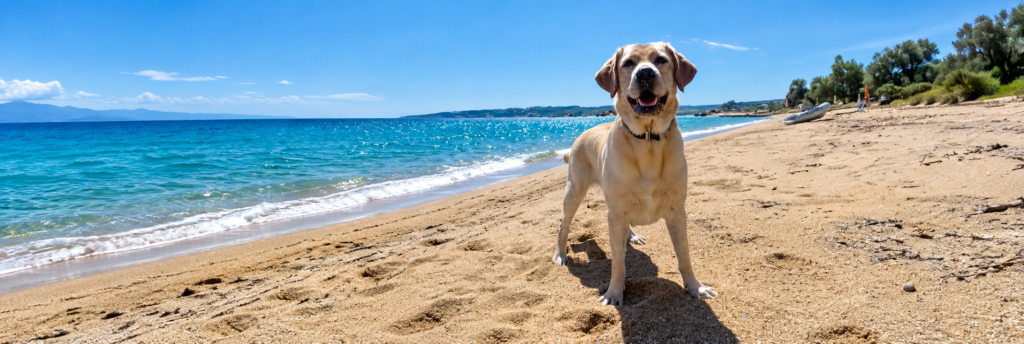
Our Labrador loves the sea and can spend a long time swimming or walking along the shore. The pug enjoys the beach too, but requires much more protection from high temperatures. Short-nosed breeds can overheat quickly, so we avoid taking him out during the hottest hours.
We normally choose quieter beaches without rows of sunbeds, where there is enough space to keep a comfortable distance from other visitors. Early morning and late afternoon are usually the best times. The beach is quieter, the sand is cooler and the sun is less intense.
Our dogs have swum at many Greek beaches without problems. However, we always check whether the section is organised, keep the dogs under control and respect anyone who prefers not to be close to animals.
That balance is important. Greece offers plenty of freedom for travellers with dogs, but that freedom works best when owners behave responsibly.
Are Dogs Allowed on Beaches in Greece?
Greek law distinguishes between organised and unorganised beaches.
Dogs are allowed on unorganised beaches and may also enter the sea. While they are outside the water, they must be kept on a lead. A quiet, undeveloped section of coastline is therefore normally the easiest option when visiting the beach with a dog.
An organised beach generally means an area operated by a beach bar, hotel or another licensed business, usually with sunbeds, umbrellas and services for visitors.
Dogs are not automatically permitted in these organised areas. They may enter if there is a clear sign showing that dogs are accepted. Assistance and therapy dogs are covered by separate legal provisions.
One beach can contain both organised and unorganised areas. The section in front of a beach bar may have rows of sunbeds, while another part of the same coastline, only a short walk away, may remain unorganised.
Bringing your own chairs and umbrella to a free section does not make it an organised beach.
Greek Law 4830/2021 also restricts access for dogs to beaches with Blue Flag certification, with legal exceptions for recognised assistance animals. Local designations can change, so always check the signs after arriving.
Responsible Behavior at the Beach
Even where dogs are legally allowed, owners should follow a few simple rules:
- Keep the dog on a lead while outside the water.
- Keep a respectful distance from other visitors.
- Immediately clean up after the dog.
- Bring fresh water, a portable bowl and shade.
- Avoid hot sand and the strongest midday sun.
- Do not allow the dog to disturb wildlife or approach unfamiliar animals.
- Rinse salt water from its coat after swimming when possible.
A long lead can be useful on a quiet beach. It gives the dog some freedom while allowing the owner to remain in control.
Responsible behaviour protects both the dog and the right of other owners to continue visiting Greek beaches with their pets.
Entering Greece with a Dog from a Non-EU Country
Travellers entering Greece from a country outside the European Union must follow the EU rules for the non-commercial movement of pets.
The main requirements can include:
- An identification microchip
- A valid vaccination against rabies
- The required waiting period after the first rabies vaccination
- An EU animal health certificate
- A declaration confirming that the journey is non-commercial
- Travel with the owner or an authorised person
The microchip must normally be implanted before the rabies vaccination for that vaccination to be considered valid for travel.
After a dog receives its first rabies vaccination, at least 21 days must usually pass before it can travel. Booster vaccinations should be given before the previous vaccination expires. If a booster is late, it may be treated as a new primary vaccination and another waiting period may apply.
Travellers entering from most non-EU countries need an EU animal health certificate completed by an official state veterinarian no more than ten days before arrival in the European Union.
A domestic vaccination booklet or pet passport should not automatically be assumed to replace the required certificate. The exact documentation depends on the country of departure and the type of passport or certificate already held by the animal.
Some travellers also need a rabies antibody titration test. This depends on whether the country of departure appears on the European Commission’s approved list.
If the test is required, the process must begin well before the journey. A blood sample is taken after vaccination and tested by an approved laboratory. An additional waiting period may apply before the dog can enter the EU.
Because requirements differ between countries, always check the latest European Union rules and consult the competent veterinary authority before travelling.
Carry the original documents and make sure the microchip number is identical on every certificate. Border authorities may check both the paperwork and the dog’s microchip.
EU non-commercial travel rules normally cover up to five pets. Different rules apply when animals are being sold, transferred to another owner or travelling without their owner.
Choosing Pet-Friendly Accommodation
Finding pet-friendly accommodation in Greece is usually not difficult, but never rely only on the pet-friendly search filter.
Contact the owner or manager before booking and request written confirmation. Some properties accept only small dogs, limit the number of animals or charge an additional cleaning fee.
Ask the following questions:
- Are dogs allowed inside the accommodation?
- Are two dogs accepted?
- Is there a size or weight restriction?
- Is there an additional fee or deposit?
- Is the garden completely fenced?
- Are dogs allowed in shared outdoor areas?
- Can the dog be left alone inside the property?

For a longer stay, a house or ground-floor apartment with a secure garden can be more practical than a small hotel room. A balcony is not a safe replacement for outdoor space, especially during summer.
Check the surrounding area on a map as well. A property may accept pets but still be located next to a busy road or far from suitable walking areas.
Reviews from previous guests travelling with dogs can reveal useful details that are missing from the official listing.
Restaurants and Outdoor Dining
Outdoor dining is one of the advantages of travelling with a dog in Greece. Many tavernas, cafés and seaside restaurants have open terraces where a calm dog may be welcomed.
Acceptance remains at the discretion of the business, so ask a member of staff before sitting down.
Choose a table away from the busiest walkway, keep the dog on a short lead and make sure it does not disturb other guests. Carry a small water bowl, although many businesses will happily provide one.
Indoor access can be more restricted, making outdoor seating the safest and most comfortable option.
Driving and Ferry Travel with Dogs
For many visitors, driving is the easiest way to explore pet-friendly Greece.
Travelling by car gives you control over stops, water, food and temperature. It also allows you to reach quieter beaches and accommodation outside crowded resorts.
Dogs should be secured using a suitable carrier, travel crate, barrier or safety harness. An unsecured dog can distract the driver and may be seriously injured during sudden braking.
Plan regular stops and keep the car cool. Never leave a dog inside a parked vehicle, even for a few minutes.
Ferry travel requires additional planning because every operator may apply different rules. Depending on the vessel, dogs may need to stay in a carrier, designated pet area or onboard kennel. Some ferries also offer a limited number of pet-friendly cabins.
Check the ferry company’s conditions before buying tickets and declare the pet during booking. Carry its documents with you instead of leaving them in the vehicle.
For longer journeys, bring water, food, waste bags and something familiar that may help the dog remain calm.
Protecting Dogs from the Greek Summer
Heat is one of the biggest risks when travelling with dogs in Greece.
Plan walks early in the morning and after sunset. Before allowing the dog to walk on pavement or sand, test the surface with your hand. If it feels uncomfortable for your hand, it is too hot for the dog’s paws.
Signs of overheating can include:
- Heavy or unusual panting
- Excessive drooling
- Weakness or poor coordination
- Vomiting
- Bright red or very pale gums
- Collapse
Move the dog into the shade, begin cooling it gradually and contact a veterinarian immediately if you suspect heatstroke.
Short-nosed dogs, older animals and dogs with health conditions need additional protection.
Before arriving, find the nearest veterinary clinic and save its telephone number. Discuss protection against ticks, fleas, mosquitoes and sand flies with your veterinarian before travelling.
Always carry fresh drinking water. Dogs should not drink seawater because consuming too much salt water can make them seriously ill.
Finding the Right Beach for Your Dog
The best dog-friendly beach is not necessarily the most famous one.
We prefer spacious, unorganised beaches with easy access, natural shade or parking nearby. Quieter beaches give dogs more space and reduce the possibility of disturbing other visitors.
Before settling down, check for sharp rocks, broken glass, fishing hooks, sea urchins and strong currents. Also look for signs concerning dogs or Blue Flag certification.
If a beach is crowded or covered with rows of sunbeds, it is usually easier to drive farther and find a peaceful unorganised section.
Satellite images can help identify less developed parts of the coastline, but signs and local conditions should always be checked after arrival.
Is Greece a Good Destination for Dogs?
Based on our experience, yes.
Greece offers outdoor living, warm weather, a long coastline and a large selection of apartments and holiday homes. Our Labrador and pug have enjoyed many trips with us, from swimming at quiet beaches to relaxing outside seaside accommodation.
The key is preparation. Carry the correct documents, book genuinely pet-friendly accommodation, understand the difference between organised and unorganised beaches and protect the dog from summer heat.
Most importantly, respect the people and environment around you. When owners clean up, use a lead and choose appropriate places, travelling through pet-friendly Greece can be enjoyable for everyone.
With a little planning, your dog does not have to miss your next Greek holiday. It can become part of the experience.